lol i was thinking about food... when this song started singing..
http://www.youtube.com/watch?v=H8KnHK1NskY
a song for mama - boys II men
so 3 frozen pizzas expired this week (27-29th) so im eating away.................this is why you shouldnt splurge and stock up a freezer full of food when they go on sale D=
Saturday, January 29, 2011

Friday, January 28, 2011
unit 4 - sketching
quick review:
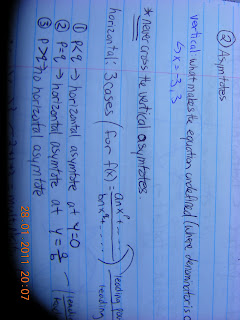
oh man why is it sideways!@!@! ugh.. okay. ... this is for sketching rational functions, so it looks like a giant fraction. vertical asymtotes are easy to determine, as they are the roots at the denominator of the fraction. now, to find the horizontal asymtote, there are three options. we look at the degrees (if they are factored) or the exponent of the leading polynomial (so the greatest exponent number) for both the numerator and denominator.
IF... the numerator's exponent is less than that of the denominator (p<q), then your horizontal asymtote is at y = 0
if p = q, then your horizontal asymtote is at the leading coefficient of the numerator divided by the leading coefficient of the denominator.
if p > q by one, then you have an oblique asymtote. this is just a straight line in the form y=mx+b. to find this equation, just divide the numerator by the denominator, and drop the remainders (they are not important). then you should have a line in the form y=mx+b which is going to be your oblique asymtote.
if p>q by more than one, you still divide the numerator by the denominator, but you'll get a quadratic function, or greater. that will be your asymtote. (this particular case is not on the exam).
keep in mind that the horizontal asymtotes only guide the end behaviours of the graph.

this is for non rational (regular?) functions:
even means: degree of the function is an even number.
odd means: degree of the function is an odd number.
negative means a is negative (or the leading coefficient is negative).
postitive means the leading coefficient is positive.
here is what a positive, even function should look like: it starts at the 2nd quadrant, and ends in the first.

this is a negative even graph, opposite to the positive even graph, it starts in quadrant three and ends in quadrant four.

this is an example of a negative but odd graph. it starts in the second quadrant and ends in the 4th quadrant. note that unlike the even graphs, one section is in a negative quadrant, while the other is in a positive quadrant.

this is an example of a positive but odd function. it should start in quadrant 3 and end in quadrant 1.

here are some sketching questions i am having trouble with:
my graphing calculator indicates that my graph should be a negative curve on the left side of the y axis (in quadrant 3), and a positive curve on the right side of the y axis (meaning the graph is in quadrant one).
where did i go wrong? or is it just the calculator.. having trouble with asymtotes?
the function is f(x) = (x^2 + 1)/x

apparantly i'm wrong here too... where did i go wrongg? f (x) = (x^3) / (x+1)

for this, i'm supposed to come up with the function that describes this graph. i didnt get it T_T i think the y-intercept is a bit confusing? i couldnt plug it in... f(0) = -1 right? it didnt work out nicely?

remember, if there are the same root(s) on the numerator and denominator, this means you have a hole in the graph. it is not necessary to include these when you're doing the sign chart since they cancel out anyway. the only thing you have to do, is to draw a hole on the graph where it would normally just be a line. just make a circle where the graph meets the root.
also, when drawing even/odd curves, the higher the exponent, the more exaggerated the bounce/influxion.
on the exam, there will be a question where the properties of the graph are described, and the question will require a graph to be drawn from those properties (concave up/down, increasing/decreasing intervals, intercepts, and points).
do not forget to label all oblique, vertical, and horizontal asymtotes, intercepts, points given, and don't forget to put in the direction of the graph (little arrow).
there is no vertical asymtote where the denominator is zero. this is undefined.
oh man why is it sideways!@!@! ugh.. okay. ... this is for sketching rational functions, so it looks like a giant fraction. vertical asymtotes are easy to determine, as they are the roots at the denominator of the fraction. now, to find the horizontal asymtote, there are three options. we look at the degrees (if they are factored) or the exponent of the leading polynomial (so the greatest exponent number) for both the numerator and denominator.
IF... the numerator's exponent is less than that of the denominator (p<q), then your horizontal asymtote is at y = 0
if p = q, then your horizontal asymtote is at the leading coefficient of the numerator divided by the leading coefficient of the denominator.
if p > q by one, then you have an oblique asymtote. this is just a straight line in the form y=mx+b. to find this equation, just divide the numerator by the denominator, and drop the remainders (they are not important). then you should have a line in the form y=mx+b which is going to be your oblique asymtote.
if p>q by more than one, you still divide the numerator by the denominator, but you'll get a quadratic function, or greater. that will be your asymtote. (this particular case is not on the exam).
keep in mind that the horizontal asymtotes only guide the end behaviours of the graph.


this is for non rational (regular?) functions:
even means: degree of the function is an even number.
odd means: degree of the function is an odd number.
negative means a is negative (or the leading coefficient is negative).
postitive means the leading coefficient is positive.
here is what a positive, even function should look like: it starts at the 2nd quadrant, and ends in the first.

this is a negative even graph, opposite to the positive even graph, it starts in quadrant three and ends in quadrant four.

this is an example of a negative but odd graph. it starts in the second quadrant and ends in the 4th quadrant. note that unlike the even graphs, one section is in a negative quadrant, while the other is in a positive quadrant.

this is an example of a positive but odd function. it should start in quadrant 3 and end in quadrant 1.

here are some sketching questions i am having trouble with:
my graphing calculator indicates that my graph should be a negative curve on the left side of the y axis (in quadrant 3), and a positive curve on the right side of the y axis (meaning the graph is in quadrant one).
where did i go wrong? or is it just the calculator.. having trouble with asymtotes?
the function is f(x) = (x^2 + 1)/x

apparantly i'm wrong here too... where did i go wrongg? f (x) = (x^3) / (x+1)

for this, i'm supposed to come up with the function that describes this graph. i didnt get it T_T i think the y-intercept is a bit confusing? i couldnt plug it in... f(0) = -1 right? it didnt work out nicely?

remember, if there are the same root(s) on the numerator and denominator, this means you have a hole in the graph. it is not necessary to include these when you're doing the sign chart since they cancel out anyway. the only thing you have to do, is to draw a hole on the graph where it would normally just be a line. just make a circle where the graph meets the root.
also, when drawing even/odd curves, the higher the exponent, the more exaggerated the bounce/influxion.
on the exam, there will be a question where the properties of the graph are described, and the question will require a graph to be drawn from those properties (concave up/down, increasing/decreasing intervals, intercepts, and points).
do not forget to label all oblique, vertical, and horizontal asymtotes, intercepts, points given, and don't forget to put in the direction of the graph (little arrow).
there is no vertical asymtote where the denominator is zero. this is undefined.
Thursday, January 27, 2011
science isn't vs creation
God uses laws. He created man and gave us laws. He created the world, space, and time. Everything we see are His works. The study of His works is called science.
Everything we learn in science has an explanation. A cause and an effect. A law can describe these relationships. We can predict what might happen. Chemical reactions are the same if they take place under the exact same situations. Doesn't it make sense that science would be logical, predictable, and put in an orderly fashion? For example, God gave us laws, the 10 commandments, and He said that if we disobeyed them then there would be a punishment. This is cause and effect. In chemistry, if we mix an acid and a base together, they will neutralize and give you water + a salt. This is a cause and effect.
Of course, it would make sense, then, that someone who was logical and orderly would have created the universe? And of course, our minds are incomparable to that of God's, so there will always be things we will not understand. Human kind was only able to discover all these laws and trends we have found in science based on the fact that we knew everything happened in a specific pattern, and cycle. Take Kepler, or Newton. These scientists were aware that a God exists, and that God does things in an orderly fashion, and makes things with a purpose. God doesn't make mistakes. He does not create junk.
Egyptian, Greek, and many other religions/religious views all see the world as eternal, that it was always here. They say that mounds of land just rose up from the waters, or the waters created land when they touched the skies.. and stuff like that. Every religion out there (other than Christianity) indicates that there was no beginning. But what are scientists saying? They are saying that "it all started with the Big Bang" (that sounds like the intro song to Big Bang Theory). So even science believes that there was a beginning, just like the Bible says in Genesis 1:1 "In the beginning". This means that God was there before the beginning - He created time. Therefore, God is outside of time. How can we, human beings who live inside time be able to comprehend a being that exists outside of time?
See, since science is the study of God's creation, then it would make sense that the more we learn about God, the more we'll learn about science, or His creation. Similarly, the more we discover in science, the more we are in awe of God's mighty power, and how awesome He is. You can see His glory just by looking around you, everything that He has made is so beautiful and flawless (well, aside from humans ruining some stuff).
Some people question Christianity because it doesn't seem to make sense. Well, if we were able to understand everything there is about Christianity, then couldn't it have been just made up? If it was logical and "made sense", then what would be the point? Then God wouldn't be so awesome, and He wouldn't be so powerful, we wouldn't need Him, and He wouldn't be a God. It makes sense to believe in something that doesn't make sense, because it proves that it wasn't man made, and it backs up the fact that we need faith in God, and believe that He sent His son to save us. If it were that simple, then why would we need faith? (see below for more)
So science isn't the opposite of creation. In fact, it backs up creation. The only problem we have is that not everything scientists "discover" is actually true. Year after year, more "studies" are conducted, and we find out that we "were wrong" before, and now we "have the right data". Like how they used to think the earth was flat, and now they say it's round. To be able to understand science better, we must understand God better. We must understand the creator to be able to understand His creation.
interesting?
If you want to know more about why we need faith:
What is faith?
Hebrews 11:1,
1 Now faith is being sure of what we hope for and certain of what we do not see.
Why do we need faith?
Romans 3: 21-31 says...
21 But now apart from the law the righteousness of God has been made known, to which the Law and the Prophets testify. 22 This righteousness is given through faith in[h] Jesus Christ to all who believe. There is no difference between Jew and Gentile, 23 for all have sinned and fall short of the glory of God, 24 and all are justified freely by his grace through the redemption that came by Christ Jesus. 25 God presented Christ as a sacrifice of atonement,[i] through the shedding of his blood—to be received by faith. He did this to demonstrate his righteousness, because in his forbearance he had left the sins committed beforehand unpunished— 26 he did it to demonstrate his righteousness at the present time, so as to be just and the one who justifies those who have faith in Jesus.
27 Where, then, is boasting? It is excluded. Because of what law? The law that requires works? No, because of the law that requires faith. 28 For we maintain that a person is justified by faith apart from the works of the law. 29 Or is God the God of Jews only? Is he not the God of Gentiles too? Yes, of Gentiles too, 30 since there is only one God, who will justify the circumcised by faith and the uncircumcised through that same faith. 31 Do we, then, nullify the law by this faith? Not at all! Rather, we uphold the law.
also see:
Romans 4:13-17,
13 It was not through the law that Abraham and his offspring received the promise that he would be heir of the world, but through the righteousness that comes by faith. 14 For if those who depend on the law are heirs, faith means nothing and the promise is worthless, 15 because the law brings wrath. And where there is no law there is no transgression.
16 Therefore, the promise comes by faith, so that it may be by grace and may be guaranteed to all Abraham’s offspring—not only to those who are of the law but also to those who have the faith of Abraham. He is the father of us all. 17 As it is written: “I have made you a father of many nations.”[c] He is our father in the sight of God, in whom he believed—the God who gives life to the dead and calls into being things that were not.
John 3:16
16 For God so loved the world that he gave his one and only Son, that whoever believes in him shall not perish but have eternal life.
(NIV)
What these passages mean in relation to us:
This passage is talking about how the price of sin is death, and everyone has sinned (3:22). Therefore, we all have earned the punishment of death. But God sent His son, Jesus Christ to die for us, in our place. It was only him who was able to do this for us because he was pure, free from sin. His death made up for all of our sins, every single one of them. God has done everything for us, so that we might live (eternally). The only thing He can not do, however, is to force us to have faith and believe in Him - because He gave us free will. We have the freedom to choose whether or not we want to live eternally, or suffer eternal death. The choice is ours to make, God has already done everything else. The promise the passage is talking about is the promise of life after death, eternal life. Also, verses 3:30 and 4:17 show that this applys not only to the Israelites (God's chosen people, if you go back and read the first few books Gen-Deut), but this applys to everyone, all the people.
But it doesn't mean everything's going to be easy once you have faith....
There's a section in my Bible (not part of the books, but its like a study guide...) and it says,
"Great prizes await those who persevere, and the very process of living by faith builds strong character."
and..
"It is tough faith: a constant commitment to hang on and believe God against all odds, no matter what."
Everything we learn in science has an explanation. A cause and an effect. A law can describe these relationships. We can predict what might happen. Chemical reactions are the same if they take place under the exact same situations. Doesn't it make sense that science would be logical, predictable, and put in an orderly fashion? For example, God gave us laws, the 10 commandments, and He said that if we disobeyed them then there would be a punishment. This is cause and effect. In chemistry, if we mix an acid and a base together, they will neutralize and give you water + a salt. This is a cause and effect.
Of course, it would make sense, then, that someone who was logical and orderly would have created the universe? And of course, our minds are incomparable to that of God's, so there will always be things we will not understand. Human kind was only able to discover all these laws and trends we have found in science based on the fact that we knew everything happened in a specific pattern, and cycle. Take Kepler, or Newton. These scientists were aware that a God exists, and that God does things in an orderly fashion, and makes things with a purpose. God doesn't make mistakes. He does not create junk.
Egyptian, Greek, and many other religions/religious views all see the world as eternal, that it was always here. They say that mounds of land just rose up from the waters, or the waters created land when they touched the skies.. and stuff like that. Every religion out there (other than Christianity) indicates that there was no beginning. But what are scientists saying? They are saying that "it all started with the Big Bang" (that sounds like the intro song to Big Bang Theory). So even science believes that there was a beginning, just like the Bible says in Genesis 1:1 "In the beginning". This means that God was there before the beginning - He created time. Therefore, God is outside of time. How can we, human beings who live inside time be able to comprehend a being that exists outside of time?
See, since science is the study of God's creation, then it would make sense that the more we learn about God, the more we'll learn about science, or His creation. Similarly, the more we discover in science, the more we are in awe of God's mighty power, and how awesome He is. You can see His glory just by looking around you, everything that He has made is so beautiful and flawless (well, aside from humans ruining some stuff).
Some people question Christianity because it doesn't seem to make sense. Well, if we were able to understand everything there is about Christianity, then couldn't it have been just made up? If it was logical and "made sense", then what would be the point? Then God wouldn't be so awesome, and He wouldn't be so powerful, we wouldn't need Him, and He wouldn't be a God. It makes sense to believe in something that doesn't make sense, because it proves that it wasn't man made, and it backs up the fact that we need faith in God, and believe that He sent His son to save us. If it were that simple, then why would we need faith? (see below for more)
So science isn't the opposite of creation. In fact, it backs up creation. The only problem we have is that not everything scientists "discover" is actually true. Year after year, more "studies" are conducted, and we find out that we "were wrong" before, and now we "have the right data". Like how they used to think the earth was flat, and now they say it's round. To be able to understand science better, we must understand God better. We must understand the creator to be able to understand His creation.
interesting?
If you want to know more about why we need faith:
What is faith?
Hebrews 11:1,
1 Now faith is being sure of what we hope for and certain of what we do not see.
Why do we need faith?
Romans 3: 21-31 says...
21 But now apart from the law the righteousness of God has been made known, to which the Law and the Prophets testify. 22 This righteousness is given through faith in[h] Jesus Christ to all who believe. There is no difference between Jew and Gentile, 23 for all have sinned and fall short of the glory of God, 24 and all are justified freely by his grace through the redemption that came by Christ Jesus. 25 God presented Christ as a sacrifice of atonement,[i] through the shedding of his blood—to be received by faith. He did this to demonstrate his righteousness, because in his forbearance he had left the sins committed beforehand unpunished— 26 he did it to demonstrate his righteousness at the present time, so as to be just and the one who justifies those who have faith in Jesus.
27 Where, then, is boasting? It is excluded. Because of what law? The law that requires works? No, because of the law that requires faith. 28 For we maintain that a person is justified by faith apart from the works of the law. 29 Or is God the God of Jews only? Is he not the God of Gentiles too? Yes, of Gentiles too, 30 since there is only one God, who will justify the circumcised by faith and the uncircumcised through that same faith. 31 Do we, then, nullify the law by this faith? Not at all! Rather, we uphold the law.
also see:
Romans 4:13-17,
13 It was not through the law that Abraham and his offspring received the promise that he would be heir of the world, but through the righteousness that comes by faith. 14 For if those who depend on the law are heirs, faith means nothing and the promise is worthless, 15 because the law brings wrath. And where there is no law there is no transgression.
16 Therefore, the promise comes by faith, so that it may be by grace and may be guaranteed to all Abraham’s offspring—not only to those who are of the law but also to those who have the faith of Abraham. He is the father of us all. 17 As it is written: “I have made you a father of many nations.”[c] He is our father in the sight of God, in whom he believed—the God who gives life to the dead and calls into being things that were not.
John 3:16
16 For God so loved the world that he gave his one and only Son, that whoever believes in him shall not perish but have eternal life.
(NIV)
What these passages mean in relation to us:
This passage is talking about how the price of sin is death, and everyone has sinned (3:22). Therefore, we all have earned the punishment of death. But God sent His son, Jesus Christ to die for us, in our place. It was only him who was able to do this for us because he was pure, free from sin. His death made up for all of our sins, every single one of them. God has done everything for us, so that we might live (eternally). The only thing He can not do, however, is to force us to have faith and believe in Him - because He gave us free will. We have the freedom to choose whether or not we want to live eternally, or suffer eternal death. The choice is ours to make, God has already done everything else. The promise the passage is talking about is the promise of life after death, eternal life. Also, verses 3:30 and 4:17 show that this applys not only to the Israelites (God's chosen people, if you go back and read the first few books Gen-Deut), but this applys to everyone, all the people.
But it doesn't mean everything's going to be easy once you have faith....
There's a section in my Bible (not part of the books, but its like a study guide...) and it says,
"Great prizes await those who persevere, and the very process of living by faith builds strong character."
and..
"It is tough faith: a constant commitment to hang on and believe God against all odds, no matter what."
Wednesday, January 26, 2011
is anything getting through to you?
i feel like im babying you.
how old are you
ahgaslkdjaslkdjsd
really?
you go around in circles, deciding nothing........... stating the obvious.. in a way that makes you sound like you're still pondering about it. oh my goodness
maybe we were brought up differently, so none of these things occur to you like they do to me. maybe there are somethings that irk you about me. and nows just the time where you're irking me.
maybe it's a bad day for you? are you groggy and out of it too????
going to chill out and take a shower.....
how old are you
ahgaslkdjaslkdjsd
really?
you go around in circles, deciding nothing........... stating the obvious.. in a way that makes you sound like you're still pondering about it. oh my goodness
maybe we were brought up differently, so none of these things occur to you like they do to me. maybe there are somethings that irk you about me. and nows just the time where you're irking me.
maybe it's a bad day for you? are you groggy and out of it too????
going to chill out and take a shower.....
lakjdlskd
so you're new at this.
thats not an excuse for not doing anything, and leaving someone else to just come and do everything for you.
ahhhgldfalfh
you're not the only one that is busy
instead of waiting until i tell you what to do, and when to do it, just do it yourself. or ask, that's so much better than just keeping quiet and not doing or saying anything. ughhhhhh
instead of pushing everything back to me when im giving you the chance to do something finally...... take the opportunity to learn something, even if you mess up a bit, how else are you going to learn?
honestly, im getting kind of annoyed. the one time i ask you to do something, instead of just doing it myself because its just easier that way..... you act like its nothing, its not important, no. salkdjsldjsakdskdjsd
dahhhhhhhhhhhhhhhhh how to be lovinggggggggggggg?!!!!!!
okay, understand from their perspective.........
- exam week, probably stressed
- but you had a week's notice...
- waiting on some details to confirm.. so it was delayed.. okay fine...
- okay i cant tell how you're saying things because its just in print... so maybe i am imagining a harsher, meaner tone than it was meant.
- taking foreverrrrrrrrr .... new at this... so you know.. it takes time....... yea.........
- im pretty much just asking things that people normally take about two seconds to find an answer to... but this is taking . way. too. long... i dont have all dayyy............ maybe im just impatient because im alsoo stressed and already annoyedddd. so this jsut adds to it.
my brain hurtsssss and im so tired..... dahhhh
maybe not because of you. maybe im just doing too much math..... and tired because..... i need more sleep!
so..... just let it be............... this isnt happenning! DONT STRESSSSSSSSS ! THINK ABOUT FOOD.............
thats not an excuse for not doing anything, and leaving someone else to just come and do everything for you.
ahhhgldfalfh
you're not the only one that is busy
instead of waiting until i tell you what to do, and when to do it, just do it yourself. or ask, that's so much better than just keeping quiet and not doing or saying anything. ughhhhhh
instead of pushing everything back to me when im giving you the chance to do something finally...... take the opportunity to learn something, even if you mess up a bit, how else are you going to learn?
honestly, im getting kind of annoyed. the one time i ask you to do something, instead of just doing it myself because its just easier that way..... you act like its nothing, its not important, no. salkdjsldjsakdskdjsd
dahhhhhhhhhhhhhhhhh how to be lovinggggggggggggg?!!!!!!
okay, understand from their perspective.........
- exam week, probably stressed
- but you had a week's notice...
- waiting on some details to confirm.. so it was delayed.. okay fine...
- okay i cant tell how you're saying things because its just in print... so maybe i am imagining a harsher, meaner tone than it was meant.
- taking foreverrrrrrrrr .... new at this... so you know.. it takes time....... yea.........
- im pretty much just asking things that people normally take about two seconds to find an answer to... but this is taking . way. too. long... i dont have all dayyy............ maybe im just impatient because im alsoo stressed and already annoyedddd. so this jsut adds to it.
my brain hurtsssss and im so tired..... dahhhh
maybe not because of you. maybe im just doing too much math..... and tired because..... i need more sleep!
so..... just let it be............... this isnt happenning! DONT STRESSSSSSSSS ! THINK ABOUT FOOD.............
unit two and three review
quick review:
ahh this is so annoying, i cant seem to turn it =( or reupload....
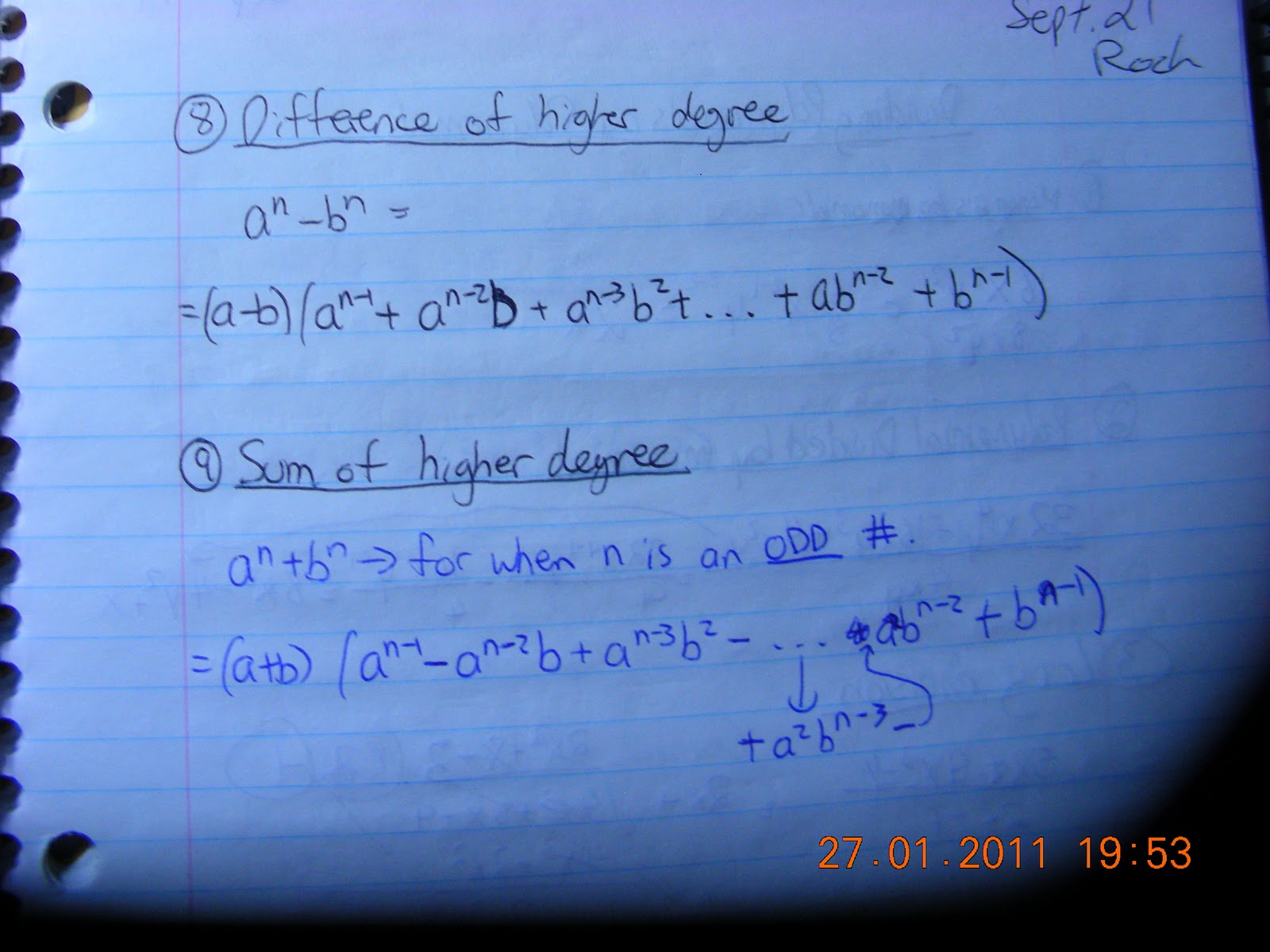
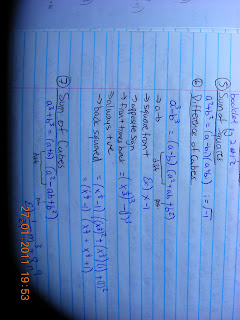
these are just sum of cubes and difference of cubes.
diff is always (a-b) (a^2 + ab + b^2)
sum is always (a+b) (a^2 - ab + b^2)

just a reminder when solving radical roots:


for absolute value inequalities... if |x| < a, then -a < x < a , x is an element of a real number:
remember this means that x is a "units" away from zero.

if they give you the answer and make you come up with the absolute value inequality...
make a number line
find out the distance between the two points they gave (if the answers are diverging)
find out the middle number.
put |x + (middle number)| >(or = to) # of steps from each point to get there:

for converging inequalities,
draw a number line
find the middle
find the distance between the points and the middle
now, this is the opposite to the diverging...so
| x + distance | < middle , i think they should be positive.. but you can test it until it works hehe

questions to look at (units 1-3)
so this was my test.. unit one lol i didnt know how to do the last two pages. ahh..........


why did i have to divide them by two? i dont get it.

trouble with e and f (ans - e = |x| < 1, f = x<1)
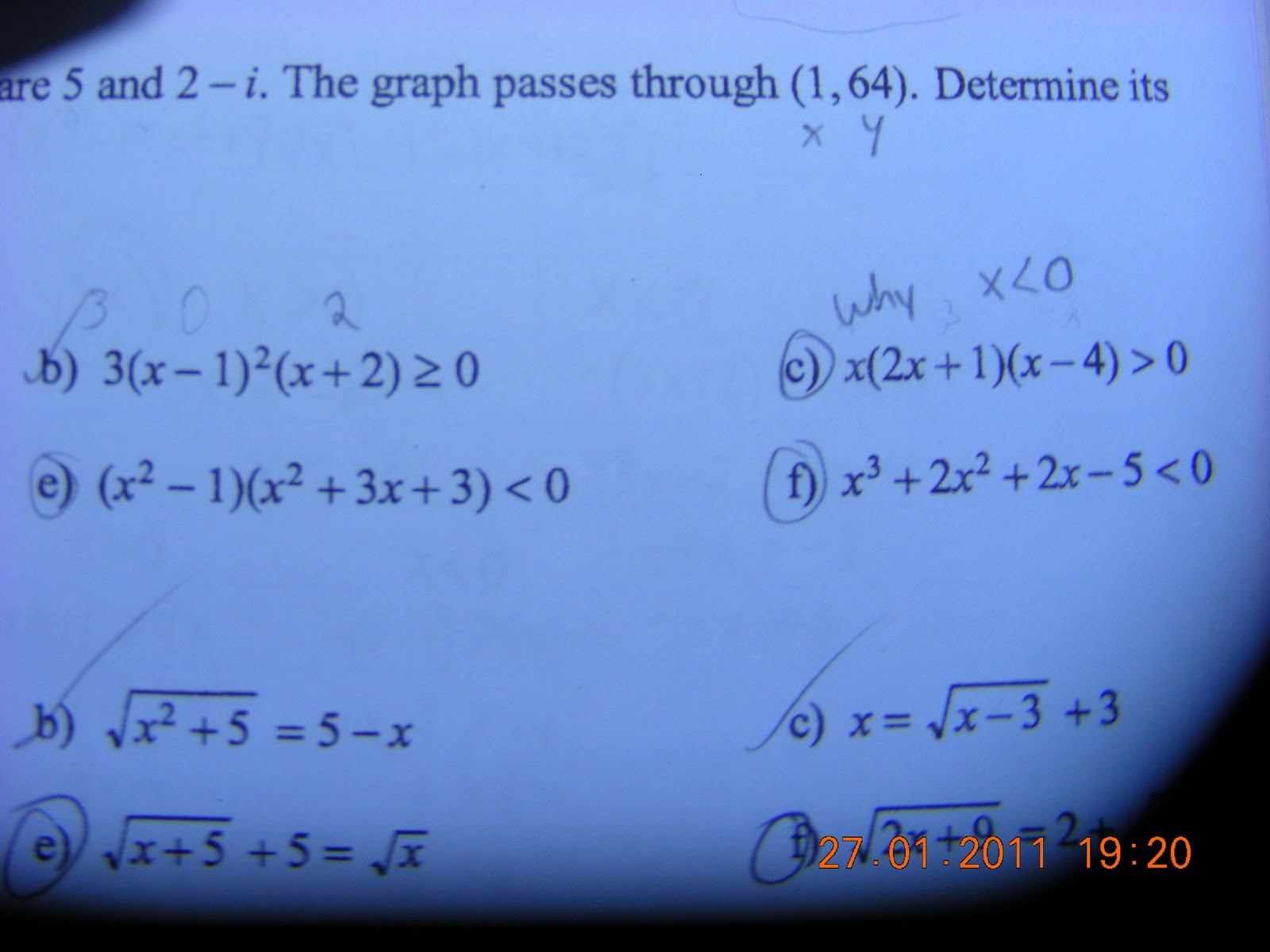
trouble with 4 ans, x = 2

19 and 25 (19 - (-infinity, 0) U (0, infinity) 25 - (-infinity, -5/3) U (5, infinity)

3c) -2 root (6x+1) = 14 , ans no solution
3e) |7x+12| < -5 , ans no solution
7c) |(x-3)/(x+5)| < 2 , ans {x| x > -7/3, or x < -13}
6d) | 2x + 5 | <(or = to) |5x + 12| , ans [-1, 1]
6e) root (x+5) + 5 = root (x) , ans undefined
6g) root (x+4) + root (x-4) = 2 (times) root (x-1) , ans x=5
8c) |3x+2| = 2x - 4 , ans undefined
Subscribe to:
Posts (Atom)